








| Introduction | History | Diagnosis | Therapy | Art | Famous People |
? sitemap masthead |
German Epilepsie Museum Kork Oberdorfstraße 8, D-77694 Kehl-Kork, Germany open Sundays 2.00 - 5.00 p.m. or by arrangement email: info@epilepsiemuseum.de |
| Introduction |
| What is epilepsy? |
| Epileptic seizures |
| Types of epilepsy |
| Causes of epilepsy |
| Therapy |
| Consequences |
| History |
| The History of Epilepsy |
| The Disease with 1000 Names |
| Institutions for people with epilepsy |
| People with epilepsy during the Nazi regime |
| Diagnosis |
| ... in the Ancient World |
| modern Methods |
| Therapy |
| ... in the Ancient World |
| ... in the Middle Ages |
| ... from the Renaissance to the Present |
| Art |
| Votive tablets |
| Religious Art |
| Other works |
| Epilepsy Motifs in literature |
| Famous People |
| Introduction |
| Gallery |
| Note |

| The History of Epileptology (epilepsy as a medial science throughout the ages) |
||
The scientific study of the clinical picture of epilepsy was not one of continuous development. |
People knew less about epilepsy in the Middle Ages than they did during the lifetime of the Greek physician Hippocrates, who had lived more than 1500 years before! |
 Hippocrates |
 Galen |
 A. of Tralleis |
 Avicenna |
 Middle Ages |
 Renaissance |
 Paracelsus |
 Tissot |
 Jackson |


|
The Disease with 1000 Names (1/3)
Hardly any other disease has been given so many different names in the course of history as epilepsy has. From this we can conclude that throughout the ages people have been preoccupied with this disease. There are two main reasons for this interest: Firstly, epilepsy has always been a common disease: 0,5-1% of all people suffer from it. |
Secondly, the image with which epilepsy is usually associated - the grand mal attack - arouses feelings of fear and horror. People have always tried to put these feelings into words. In addition to this, epilepsy can have very different symptoms, all of which need to be described and given a name. |
|
The Disease with 1000 Names (2/3)
This naming of a person, an object and also an illness was in former centuries of much greater importance than it is today. To be able to give someone a name or to find out the name of someone else meant having power over that person, whereas the inability to name something was tantamount to being powerless (as in the phrase "unspeakable misery"). Thus, people believed or hoped that if they could give a name to a disease, they would not fall victim to it. |
From the various names which a disease is given over time, we can deduce what the people in each period thought about its cause (e.g. "lunatism" - a disorder caused by the phases of the moon; "daemonic suffering": brought about by evil spirits). At the same time, the names can also tell us about the people who gave them and their beliefs (e.g. "the scourge of Christ": the person who gave this name to epilepsy definitely believed in Christ and his power to punish). |
|
The Disease with 1000 Names (3/3)
By looking at the different names which epilepsy was given throughout the ages, it is possible to piece together some of the medical, cultural and social history surrounding this disease. One example for this theory is the ancient Egyptian name for epilepsy "nesejet", which is explained in more detail here. 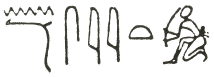 |
To the ancient Egyptians the term 'nsjt' (= nesejet = epilepsy) signified a disease which was sent by the gods and which was extremely dangerous. |
|
Institutions for people with epilepsy (1/2)
There were no special institutions for people with epilepsy in Germany until the second half of the 19th century. Where it was not possible for people with epilepsy to be cared for in their family, either because their seizures were too serious or too frequent or because they had some additional mental or physical handicap, they were put in prisons, "lunatic asylums" or former leprosoria places where people with leprosy could live). The first home for "epileptics" in Germany was opened by Dr H.A. Reimer in Görlitz in 1855. |
In 1862 a special institution for people with epilepsy was opened near Tettnang on Lake Constance, called the "Heil- und Bewahrungsanstalt für Epileptische auf der Pfingstweide". In 1867 a nursing home for epileptic boys was set up near Bielefeld. This was the foundation stone on which the epilepsy centre Bethel was later erected. In 1892 the "Heil- und Pflegeanstalt für epileptische Kinder" (Nursing Home for Epileptic Children) was inaugurated in Kork.  ›› Kork "Schloss" |
Institutions for people with epilepsy (2/2)
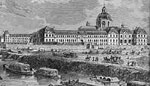 ›› The "Salpêtrière" in Paris France had led the way in this development and set up the "Hôpital de la Salpêtrière" in the former saltpetre storage depot of a gunpowder factory in Paris. As early as the 18th and the beginning of the 19th century, mentally ill people and people with epilepsy were able to get proper treatment and care here. |
Throughout the 19th century, the "Salpêtrière" (for women) and the "Hospice de Bicêtre" for men, which was later built on, developed into respected centres for people with epilepsy and those with neurological and mental disorders. |
|
During the "Third Reich", most people, including doctors, regarded the 'falling sickness' as a hereditary disease. It is unclear whether the doctors were blinded by the theories of racial hygiene or whether they did not have the medical knowledge to know any better. Some of the most inhuman actions of the National Socialists in the "Third Reich" were the measures to insure racial hygiene, one of which was the Law for the Prevention of Offspring with Hereditary Diseases which was passed by the government of the Reich on July 14th 1933. |
The measures for insuring racial hygiene reached a sad height in the rulers of the "Third Reich's" so-called euthanasia operation T4 (T4 stood for 'Tiergartenstrasse 4' in Berlin, the address of the authority responsible for this operation). More than 70,000 handicapped people fell victim to the killing between 1940 and 1941 - 20% of all people who lived in homes for the handicapped. |
|
The handicapped people were rounded up and put into the notorious grey busses belonging to the GEKRAT and transported to the extermination institutions. Grafeneck Castle on the Swabian Alb, which had been an institution run by the 'Samaritans', was seized by the authorities in 1939 and converted into the first 'gassing institution' in the Reich. 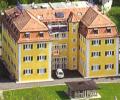 ›› Grafeneck Castle In 1940 more than 10,000 handicapped people - including many who had epilepsy - were murdered in Schloss Grafeneck alone. |
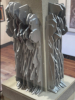 ›› "Excluded" In 1940, a total of 113 people with epilepsy were taken from the Kork institutions and taken to in two transports to Grafeneck, where they were immediately gassed. Mitte 1941 hatte die T4-Aktion ihr furchtbares "Plansoll" erreicht. Inzwischen hatten aber ausländische Gegenstimmen und kirchlicher Widerstand in Deutschland selbst eine Fortsetzung der zentral organisierten Unternehmung erschwert. In der Folgezeit wurde deshalb die Vernichtungs- aktion dezentral in einigen Anstalten durch Nahrungsentzug und Injektion tödlicher Gifte weitergeführt. |

| About the museum | Access | Discovery of the Day | Library |
| How to react to a seizure |


 loaf of bread: t
 cobra:
 man with stick: